Christian Revival Leadership: Failure, Accountability & Spiritual Awakening
8–10 minute read.
The Promise and Pressure of Christian Revival
We rightly celebrate what happens during Christian revival and spiritual awakening. It can feel as though heaven is breaking into ordinary life: lives are transformed, communities begin to heal, compassion moves beyond church walls, and testimonies multiply. Revival is compelling because it reminds us that God still moves, not only in the pages of history but in the present day.
Yet accounts of revival often emphasise the victories and minimise the cost. We may pass quickly over leadership mistakes, wrongdoing and scandal because painful events can be difficult to reconcile with genuine spiritual fruit. Psychological research into the fading affect bias suggests that the emotional impact of negative autobiographical memories can diminish more quickly than that of positive memories. A 2025 study involving 12,314 autobiographical memories found evidence for this effect, although collective religious history is considerably more complex than personal memory.
Something similar may influence how individuals remember revival. We readily recall conversions, remarkable answers to prayer and powerful encounters with God. But if we overlook the failures and pressures that unfolded alongside them, we risk losing lessons that could help today’s church prepare more wisely.
Revival history contains both beauty and brokenness. Extraordinary spiritual awakening can take place alongside ordinary human weakness. Rather than undermining faith, an honest account allows us to learn from those who went before us, both from what they did well and from what they got wrong.
Why Christian Revival Leadership Requires Preparation
Church leaders can find themselves drawn into revival without first assessing its likely impact on them, their families and their congregations. In Luke 14:25–33, Jesus teaches the importance of counting the cost of discipleship. The same principle of sober preparation can be applied when churches pray and prepare for revival and spiritual awakening. Urgency may be sincere, but moving forward without healthy structures and safeguards can leave leaders and communities exposed.
Across cultures, similar risks recur in revival movements. Sexual misconduct, financial exploitation, controlling behaviour and doctrinal extremism can emerge when leaders are elevated and accountability becomes weak. God’s work in people may remain real even when leaders fail, but the credibility, reach and duration of a movement can be damaged when serious wrongdoing is left unchallenged and leadership becomes centred on one personality.
Not every revival or awakening is documented in equal detail. Even so, the digital age gives us access to a wider range of records and perspectives than previous generations possessed. Learning from past mistakes is not easy, but taking them seriously can help today’s church recognise warning signs and avoid repeating familiar patterns.
What Revival History Teaches About Leadership Failure
Across global revival history, one striking pattern emerges: spiritual awakening often brings extraordinary fruit alongside very human leadership vulnerabilities. To explore this more closely, this article considers twelve revival movements, renewal movements and comparative cases from different periods and regions of the world, looking at the pressures their leaders faced and whether those pressures appear to have limited the movement’s wider impact.
The twelve cases include the First and Second Great Awakenings, Welsh Revival, Healing Revival, Latter Rain movement and Toronto Blessing in the West; the Pyongyang Revival and later Korean prayer and megachurch movements; the East African Revival; selected neo-Pentecostal and prosperity ministries in Latin America; the Azusa Street Revival; and the remarkable expansion of Christianity in post-Mao China.
The cases reveal a complex picture. Some involved documented moral or financial misconduct, while others were shaped by theological controversy, internal conflict, concentrated authority, exhaustion, persecution or the immense strain of sustaining rapid spiritual growth. These examples should not all be treated as equivalent.
The Azusa Street Revival, for example, combined far-reaching influence with theological disputes, leadership tensions and racial conflict, yet its impact extended well beyond the original mission. Its enduring significance illustrates how the influence of a revival can spread far beyond its original location and leadership, even when the movement itself experiences significant tensions.
They represent different kinds of movements, historical settings and leadership challenges, but together they provide a useful cross-section through which to explore the pressures surrounding Christian revival leadership.
Four Areas of Leadership Risk and Vulnerability
Revival history shows that leadership challenges take many forms, from serious moral failure to the ordinary limits of human strength. Four broad areas of risk and vulnerability emerge:
- Moral and ethical failure: sexual misconduct, financial abuse, exploitation or the misuse of spiritual authority.
- Theological and doctrinal problems: questionable teaching, disputed prophecy, contested revival practices or the elevation of individual leaders and their authority.
- Leadership dysfunction: excessive control, coercion, manipulation, concentrated authority, unresolved conflict and weak accountability.
- Human vulnerability and external pressure: exhaustion, declining health, emotional strain, persecution and political pressure.
These distinctions matter. Exhaustion is not sin, persecution is not leadership failure, and theological disagreement should not automatically be labelled false doctrine. At the same time, documented abuses of money, sexuality or spiritual authority should not be softened into mere “human weakness”. Revival history becomes much more useful when we distinguish carefully between wrongdoing, poor leadership, human frailty and pressures beyond a leader’s control.
What the Twelve Cases Reveal
A descriptive review of these twelve movements and comparative cases reveals five notable patterns. These figures describe this selected sample only and should not be interpreted as statistics for global revival history as a whole. Because several categories overlap, the percentages should not be added together.
- Documented individual leader misconduct: 8% (1 of 12)
Cases involving clearly documented personal misconduct by a specifically identifiable leader, rather than broader organisational or theological controversy. - Other leadership pressures or controversies: 75% (9 of 12)
Cases involving significant leadership challenges such as internal conflict, contested prophetic claims, concentrated authority or disputes over leadership direction and practice. - Theological or doctrinal controversy: 50% (6 of 12)
Cases involving significant disagreement or controversy over theology, doctrine, spiritual practices or the interpretation of revival experiences. - Human vulnerability or external pressure: 25% (3 of 12)
Cases significantly affected by pressures not necessarily arising from leadership wrongdoing, such as exhaustion, declining health, persecution or political pressure. - Partial, possible or mixed impact: 83% (10 of 12)
Cases where leadership pressures or controversies affected the movement to varying degrees, but were not assessed as completely derailing its wider influence or continuation.
These findings are descriptive, not predictive. The twelve cases were selected to explore a range of historical periods, geographical regions and leadership challenges rather than through a systematic survey of every Christian revival. Some describe individual awakenings, while others encompass broader movements spanning decades and countries. The figures should therefore be understood as a summary of this selected twelve-case sample, not as a statistical measurement of global revival history.
Why Revival Must Become Bigger Than Its Leaders
What is equally striking is that a revival is rarely the work of one individual. Again and again, renewal has spread beyond its most visible leaders through ordinary believers, prayer networks, local churches and decentralised leadership.
The 1907 Pyongyang Revival, for example, helped establish practices including early-morning and all-night prayer within Korean Protestant spirituality. The East African Revival developed through fellowships, itinerant teams, testimony and practices of confession across national boundaries. The post-Mao expansion of Protestant Christianity in China similarly illustrates substantial Christian growth alongside significant political and institutional pressures.
Taken together, these global examples point towards a broad historical pattern rather than a statistical conclusion. Leadership vulnerability appears frequently, but its nature and consequences vary enormously. Some movements survived serious controversy after spiritual momentum had spread beyond one personality. In other cases, concentrated authority meant that the failure of a prominent leader caused profound harm and damaged public credibility.
The lesson is not that revival inevitably produces leadership failure, but that periods of rapid spiritual growth can place significant pressure on leaders and leadership structures, sometimes exposing vulnerabilities that may have been less visible under ordinary circumstances.
Revival history presents a powerful paradox: God works through imperfect people, yet grace does not remove the need for character, wisdom and accountability. The more a movement depends upon one charismatic personality, the greater the potential consequences when that leader struggles or falls. Conversely, when leadership, responsibility and accountability are shared, a movement is less dependent on any single individual and may be better positioned to continue through periods of difficulty.
Perhaps the most important question, therefore, is not how often revival leaders fail, but what enables a spiritual awakening to remain healthy when human limitations and leadership vulnerabilities emerge.
How Accountability Protects a Move of God
This is precisely why accountability in Christian revival leadership matters. Passion alone is not enough. Structures, safeguards, shared leadership and transparent practices can help protect both a movement and its people from the vulnerabilities of its leaders. Before longing for revival, the church must learn how to steward it, not only through prayer and spiritual hunger but through wisdom, humility and healthy oversight.
Revival history suggests that movements can become less vulnerable to the failure or exhaustion of a single leader when responsibility is shared rather than heavily centralised. Shared leadership can distribute responsibility, broaden participation and reduce dependence upon one personality, although structures alone cannot guarantee healthy leadership and accountability.
Research into Christian shared leadership identifies potential benefits including increased trust and improved performance, while also recognising that its effectiveness depends on factors such as the maturity of the leadership team, the level of trust between its members, and the nature of the decisions being made.
Within the movements and comparative cases examined here, complete collapse resulting from the failure of a single leader is not the dominant pattern. Several movements continued despite leadership difficulties or controversy, suggesting that revival may prove more resilient when it has spread beyond one personality.
Factors that may contribute to that resilience include:
- Decentralised or shared leadership
- Participation by ordinary believers
- Strong local churches, prayer networks and communities
- Spiritual practices, such as prayer, discipleship and evangelism, that continue beyond the original revival generation
- The ability to endure external pressures such as persecution, political upheaval or war
Perhaps the deeper lesson is that we should prepare responsibly for what we pray expectantly to receive. A healthy longing for spiritual awakening should be matched by humility, shared responsibility, financial transparency, pastoral care, biblical and theological grounding, and clear accountability.
Within a Christian understanding, grace is not negated by failure. When leaders genuinely repent and communities pursue truth, justice and healing, failure may become a source of hard-earned wisdom for the next generation. Redemption does not erase consequences, remove the need to protect those who have been harmed or automatically restore a fallen leader to public ministry. Grace and accountability work together in parallel.
Women in Christian Revival Leadership
One further pattern in revival history is easy to overlook: the relative absence of women from many of the most visible and formally recognised leadership positions. This does not mean women were absent from revival. Women have played important roles in evangelism, prayer, teaching, organisation and Christian ministry, while historical and denominational restrictions frequently limited their opportunities for formal public leadership.
Phoebe Palmer, for example, became an influential prayer leader, author and important figure in the nineteenth-century Holiness movement. The United Methodist Church describes Phoebe Palmer as a key figure in the movement whose leadership helped pave the way for subsequent women preachers and ministry leaders. United Methodist historical material also records that Phoebe Palmer preached at more than 300 revival camp meetings.
Other significant examples include Catherine Booth, Pandita Ramabai, Kathryn Kuhlman and Woodworth-Etter. Together with Phoebe Palmer, these examples remind us that women were not simply supporting revival from the margins. In significant movements, women emerged as influential leaders, organisers, teachers and evangelists.
At the same time, the overwhelming presence of men within historically recognised formal leadership means we should be cautious in interpreting the fact that most leadership failures examined in this article involve men. The historical leadership pool itself was heavily weighted towards men.
Revival history does not allow us to conclude that women are inherently less likely to fail, or that increasing the number of women in leadership automatically prevents abuse, doctrinal error or unhealthy concentrations of power. A more defensible lesson is that the church benefits when it recognises the gifts of the whole body of Christ and avoids making spiritual movements overly dependent upon a narrow group of leaders, particularly in a global church where senior leadership remains predominantly male.
Broadening participation, including recognising appropriately gifted women and men in leadership, can bring more voices, experiences and perspectives into a movement. Whether that produces stronger accountability ultimately depends upon the structures, relationships and culture surrounding those leaders. Diversity may strengthen leadership, but it cannot substitute for character, transparency, theological depth and meaningful oversight.
Conclusion
The central challenge is therefore not simply how revival begins, but how spiritual awakening is stewarded faithfully once it comes. Prayer, preaching and spiritual hunger may help ignite renewal, but enduring fruit also requires character, shared responsibility, pastoral wisdom, biblical teaching and practice, and accountable leadership.
Revival history is not simply a story of heroes and failures. It is a story of extraordinary spiritual hunger carried by imperfect people and vulnerable communities. The challenge for today’s church is neither to romanticise the past nor become cynical about revival, but to learn from both its beauty and its brokenness.
If we pray for awakening, perhaps we must also ask whether our leaders, churches and accountability structures are ready to carry the weight of what we are asking God to do.
Questions for Reflection
- What does it reveal about God’s character that He chooses imperfect people to lead His work?
- How can recognising our own vulnerabilities make us more open to God’s grace, accountability and shared leadership?
- How might revival leadership be strengthened through accountable structures that include women’s voices and avoid personality-driven ministry?
We’d love to hear what you think. Leave a comment or question and tell us what practices you believe can help revival leaders remain accountable, resilient and centred on Christ.
Key References and Further Reading:
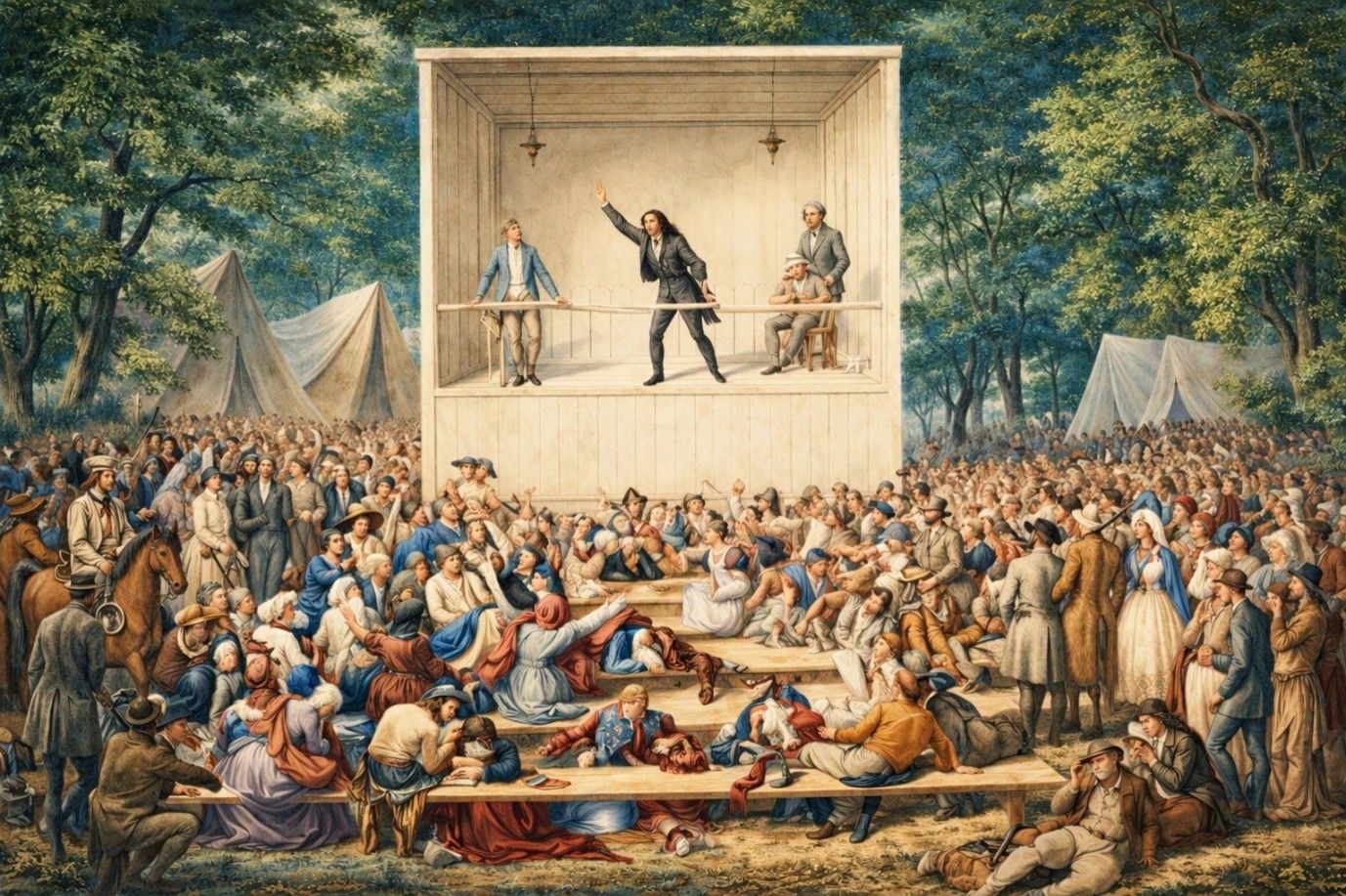
- Blog image: J. Maze Burbank, Religious Camp Meeting (1839), watercolour. Old Dartmouth Historical Society–New Bedford Whaling Museum, New Bedford, Massachusetts. Reproduced by NCpedia, citing the Library of Congress exhibition Religion and the Founding of the American Republic. NCpedia identifies the original artwork as public domain. The blog image is an AI-enhanced interpretation of the original, not an unaltered reproduction. NCpedia: Religious camp meeting. Accessed 6 November 2026.
- Sung-Deuk Oak, Major Protestant Revivals in Korea, 1903–35, Studies in World Christianity, Vol. 18, No. 3 (2012), pp. 269–290. A scholarly examination of major Korean revivals, including the 1907 Pyongyang Revival. [archive.org], [ixtheo.de]
- Brian Stanley, The East African Revival: African Initiative within a European Tradition, Churchman, Vol. 92, No. 1 (1978), pp. 6–22. A peer-reviewed historical study of the East African Revival and its development within the regional church. [research.ed.ac.uk], [churchsociety.org]
- Xiaoxuan Wang, Maoism and Grassroots Religion: The Communist Revolution and the Reinvention of Religious Life in China, Oxford University Press (2020). Examines religious life under and after Mao and the historical roots of China's post-Mao religious revival. [academic.oup.com]
- David Edwin Harrell Jr., All Things Are Possible: The Healing and Charismatic Revivals in Modern America. A major historical study of the post-war Healing Revival and charismatic revivalism.
- Richard M. Riss, A History of the Latter Rain Movement. A detailed historical account of the emergence and development of the Latter Rain movement.
- Margaret M. Poloma, Main Street Mystics: The Toronto Blessing and Reviving Pentecostalism. A sociological study of the Toronto Blessing and contemporary charismatic renewal.
- David Martin, Tongues of Fire: The Explosion of Protestantism in Latin America. A major study of the development and remarkable growth of Protestant and Pentecostal Christianity in Latin America.
- Joe Creech, Visions of Glory: The Place of the Azusa Street Revival in Pentecostal History, Church History, Vol. 65, No. 3 (1996), pp. 405-424. A scholarly reassessment of the Azusa Street Revival and its place in the development of global Pentecostalism. [jstor.org]
- United Methodist Church, Unsung Heroes of Methodism: Phoebe Palmer. Describes Phoebe Palmer as an influential prayer leader and key figure in the nineteenth-century Holiness movement whose leadership helped pave the way for subsequent women preachers and ministry leaders. [umc.org]
- United Methodist Church, Methodist History: Revivalist Phoebe Palmer. Records Phoebe Palmer's extensive revival ministry, including preaching at more than 300 revival camp meetings. [umc.org]
- Sophie Hoehne and Daniel Zimprich, Evidence for a Fading Affect Bias in Subjectively Assessed Affect Changes in Autobiographical Memory, Frontiers in Psychology (2025). Provides the psychological research underpinning the article's discussion of how the emotional impact of negative memories can fade more strongly than positive ones. [frontiersin.org]
- Marlon C. Robinson, Shared Leadership: A Rediscovery of an Old Paradigm and its Historical Context, Journal of Applied Christian Leadership, Vol. 12, No. 2 (2018), pp. 54–70. Explores shared leadership in Christian contexts, including potential benefits and limitations. [jacl.andrews.edu], [digitalcom...ndrews.edu]
A note on sources: Revival history is interpreted differently across Christian traditions, and the available evidence varies considerably between movements, countries and historical periods. The leadership assessments in this article therefore represent a comparative reading of selected historical examples rather than a statistical survey of global Christian revival. The descriptive percentages relate only to the twelve movements and comparative cases examined in the accompanying table.
Share our blog: